Overview

A management system standard to improve organization's environmental performance by protecting the environment.

ISO 14001 is an international standard on environmental management system. It provides a framework for the organization to protect the environment and respond to unstable environmental conditions with considering the balance with social and economic needs.


For whom?

Any organization can use the standard and obtain its certification regardless of the size and type of industrial sector.


What is the target of the standard?

ISO 14001 provides requirements for the organization who wishes to realize the followings.

  • Improvement of environmental performance
  • Fulfillment of compliance obligations
  • Achievement of environmental objectives

What is the merit to obtain its certification?

  • Reduction and avoidance of environmental risks
  • Cost reduction through energy and resource saving
  • Enhancement of legal compliance obligations
  • Control of KPI (Key Performance Indicator)
  • Enhancement of organizational value through continual improvement
  • Access to the global market

Structure of the standard

Foreword  
Introduction
  • 0.1 Background
  • 0.2 Aim of an environmental management system
  • 0.3 Success factors
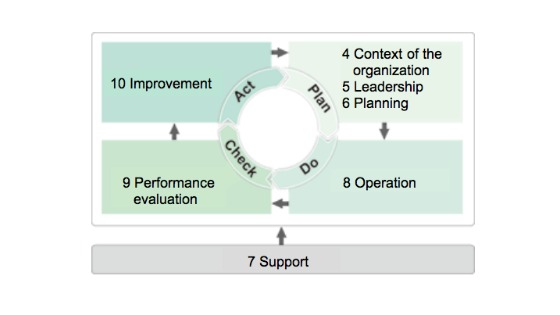
  • 0.4 Plan-Do-Check-Act model
  • 0.5 Contents of this International Standard
1 Scope  
2 Normative references  
3 Terms and definitions
  • 3.1 Terms related to organization and leadership
  • 3.2 Terms related to planning
  • 3.3 Terms related to support and operation
  • 3.4 Terms related to performance evaluation and improvement
4 Context of the organization
  • 4.1 Understanding the organization and its context
  • 4.2 Understanding the needs and expectations of interested parties
  • 4.3 Determining the scope of the environmental management system
  • 4.4 Environmental management system
5 Leadership
  • 5.1 Leadership and commitment
  • 5.2 Environmental policy
  • 5.3 Organizational roles, responsibilities and authorities
6 Planning
  • 6.1 Actions to address risks and opportunities
    • 6.1.1 General
    • 6.1.2 Environmental aspects
    • 6.1.3 Compliance obligations
    • 6.1.4 Planning action
  • 6.2 Environmental objectives and planning to achieve them
    • 6.2.1 Environmental objectives
    • 6.2.2 Planning actions to achieve environmental objectives
7 Support
  • 7.1 Resources
  • 7.2 Competence
  • 7.3 Awareness
  • 7.4 Communication
    • 7.4.1 General
    • 7.4.2 Internal communication
    • 7.4.3 External communication
  • 7.5 Documented information
    • 7.5.1 General
    • 7.5.2 Creating and updating
    • 7.5.3 Control of documented information
8 Operation
  • 8.1 Operational planning and control
  • 8.2 Emergency preparedness and response
9 Performance evaluation
  • 9.1 Monitoring, measurement, analysis and evaluation
    • 9.1.1 General
    • 9.1.2 Evaluation of compliance
  • 9.2 Internal audit
    • 9.2.1 General
    • 9.2.2 Internal audit programme
  • 9.3 Management review
10 Improvement
  • 10.1 General
  • 10.2 Nonconformity and corrective action
  • 10.3 Continual improvement
Annex A (Informative) Guidance on the use of this International Standard
Annex B (Informative) Correspondence between ISO 14001:2015 and ISO 14001:2004